
Summary
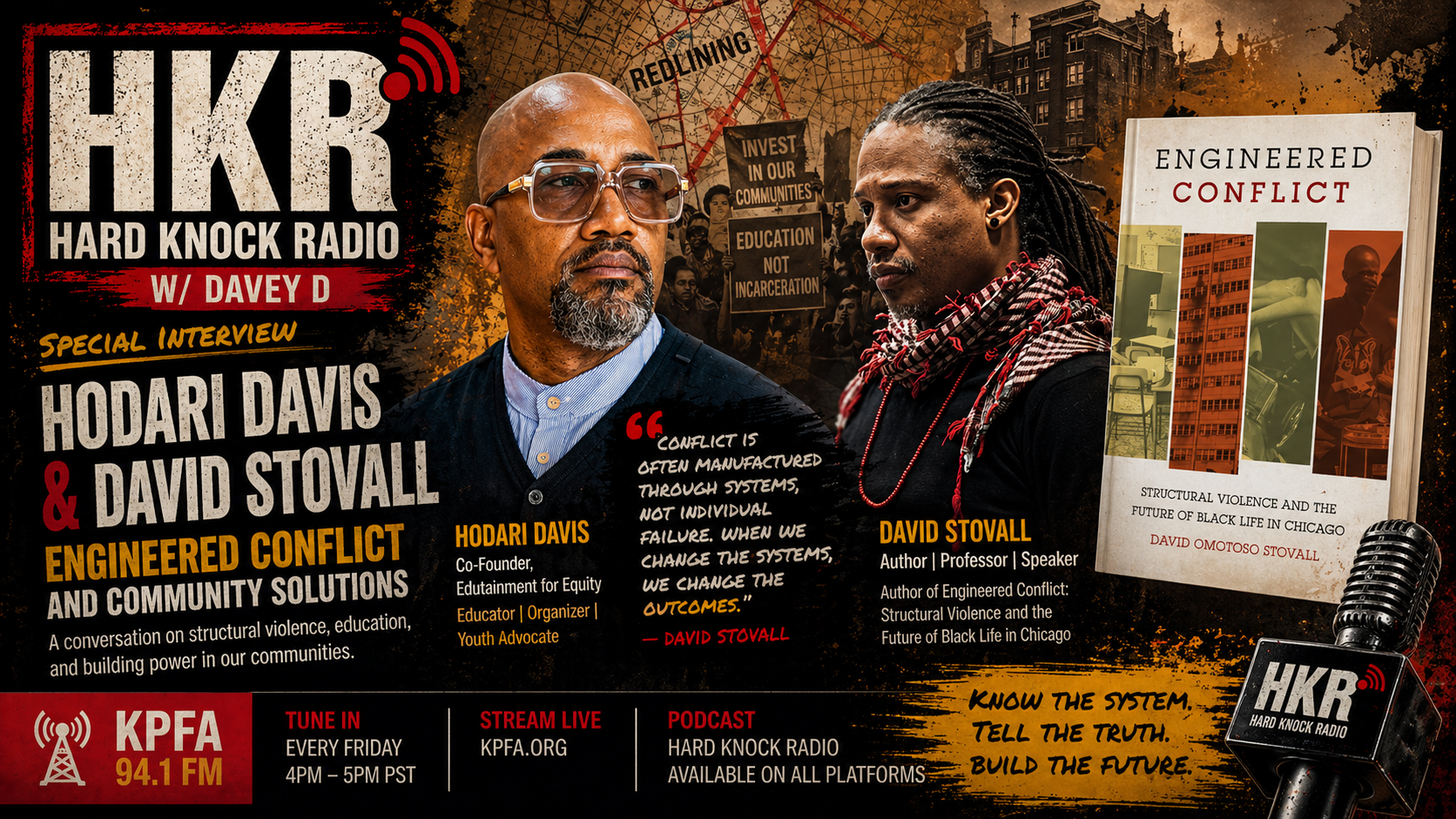
(HKR -04-26)Davey D sits down with author and educator David Stovall and Hodari Davis, co founder of Edutainment for Equity, for a critical discussion on structural violence and the concept of “engineered conflict.” Drawing from Stovall’s work, the conversation unpacks how systemic policies in housing, education, and policing have created conditions that destabilize Black and Brown communities.
Stovall explains that what many people see as isolated incidents of crime or dysfunction are often the predictable outcomes of long term policy decisions. From school closures to economic displacement, these systems produce inequality while shifting blame onto the communities most impacted.
Hodari Davis brings a grounded, solutions oriented perspective, highlighting the work of Edutainment for Equity. He emphasizes the importance of culturally rooted programming, youth engagement, and community based interventions that address root causes rather than symptoms.
Davey D ties these insights to broader media narratives, pointing out how public perception is shaped in ways that obscure systemic responsibility. Together, the conversation challenges listeners to rethink how conflict is understood and to recognize the role of policy, power, and narrative in shaping lived realities.
Guests: David Stovall, Author and Professor; Hodari Davis, Co Founder of Edutainment for Equity
Host: Davey D, Hard Knock Radio
Topic: Structural violence, engineered conflict, education, community intervention, youth advocacy
Key Takeaways
- Structural violence is produced through deliberate policy decisions
- “Engineered conflict” reframes how we understand instability in communities
- Education systems play a central role in shaping opportunity and inequality
- Community driven solutions exist but are often under-resourced
- Changing narratives is key to shifting policy and public understanding
Key Quotes / Moments
- Conflict is often manufactured through systems, not individual failure
- Policies shape outcomes long before individuals are blamed
- Communities already hold solutions, but lack institutional support
Segment Breakdown (10 Minute Intervals)
0:00 – 10:00 | Framing Engineered Conflict and Shifting the Lens
Davey D opens by introducing David Stovall and Hodari Davis and immediately reframes the conversation away from individual behavior toward systemic analysis. Stovall introduces the concept of “engineered conflict,” explaining that many of the crises seen in urban communities are not accidental but the result of long term planning, policy decisions, and structural neglect.
This segment establishes a critical foundation by challenging dominant narratives that blame individuals for conditions created by systems. Davey D emphasizes how this framework helps explain patterns seen not just in one city, but across the country. The tone is set for a conversation that is both analytical and grounded in lived experience.
10:00 – 20:00 | Breaking Down Structural Violence in Real Terms
Stovall dives deeper into the mechanics of structural violence, pointing to specific policy areas such as housing segregation, school closures, and economic disinvestment. He explains how these policies create environments where instability becomes normalized and opportunities are limited.
Davey D draws connections between these structural conditions and how they are often misrepresented in media narratives. Instead of acknowledging policy driven causes, the focus is placed on crime or behavior. This segment provides a clear breakdown of how systemic forces shape everyday realities and why understanding these connections is critical.
20:00 – 30:00 | Hodari Davis and Community Based Intervention
Hodari Davis shifts the conversation toward solutions, offering insight into the work of Edutainment for Equity. He explains how the organization engages youth and families through culturally relevant programming, mentorship, and advocacy.
Hodari emphasizes that effective intervention must come from within the community and be rooted in trust and lived experience. He discusses the importance of addressing underlying issues such as trauma, lack of resources, and systemic barriers. Davey D highlights how these approaches contrast with punitive systems that often criminalize rather than support.
This segment grounds the conversation in real world practice and demonstrates that alternatives to systemic failure already exist.
30:00 – 40:00 | Education as a Battleground for Equity and Inequality
The conversation turns to education, with Stovall and Hodari discussing how schools can either reinforce or challenge structural inequality. Stovall speaks on the impact of school closures, resource disparities, and policy decisions that disproportionately affect marginalized communities.
Hodari adds perspective on how youth experience these systems and the importance of creating educational spaces that affirm identity and potential. Davey D raises questions about access, funding, and long term outcomes, connecting these issues to broader patterns of inequality.
This segment highlights education as a key site where structural violence is both reproduced and contested.
40:00 – End | Narrative Power, Policy Change, and Collective Responsibility
In the final segment, the conversation expands to the role of narrative and public perception. Davey D, Stovall, and Hodari discuss how media framing influences how communities are understood and how policies are justified.
They emphasize that changing narratives is essential to changing outcomes. When communities are consistently portrayed as problems, it becomes easier to justify disinvestment and punitive measures. Conversely, telling accurate, nuanced stories opens the door for more just policies.
The conversation closes with a call to action, urging listeners to engage critically with the systems around them and to support community driven solutions. The tone is both urgent and forward looking, emphasizing that while the challenges are systemic, so are the possibilities for change.











Leave a Reply