
Summary
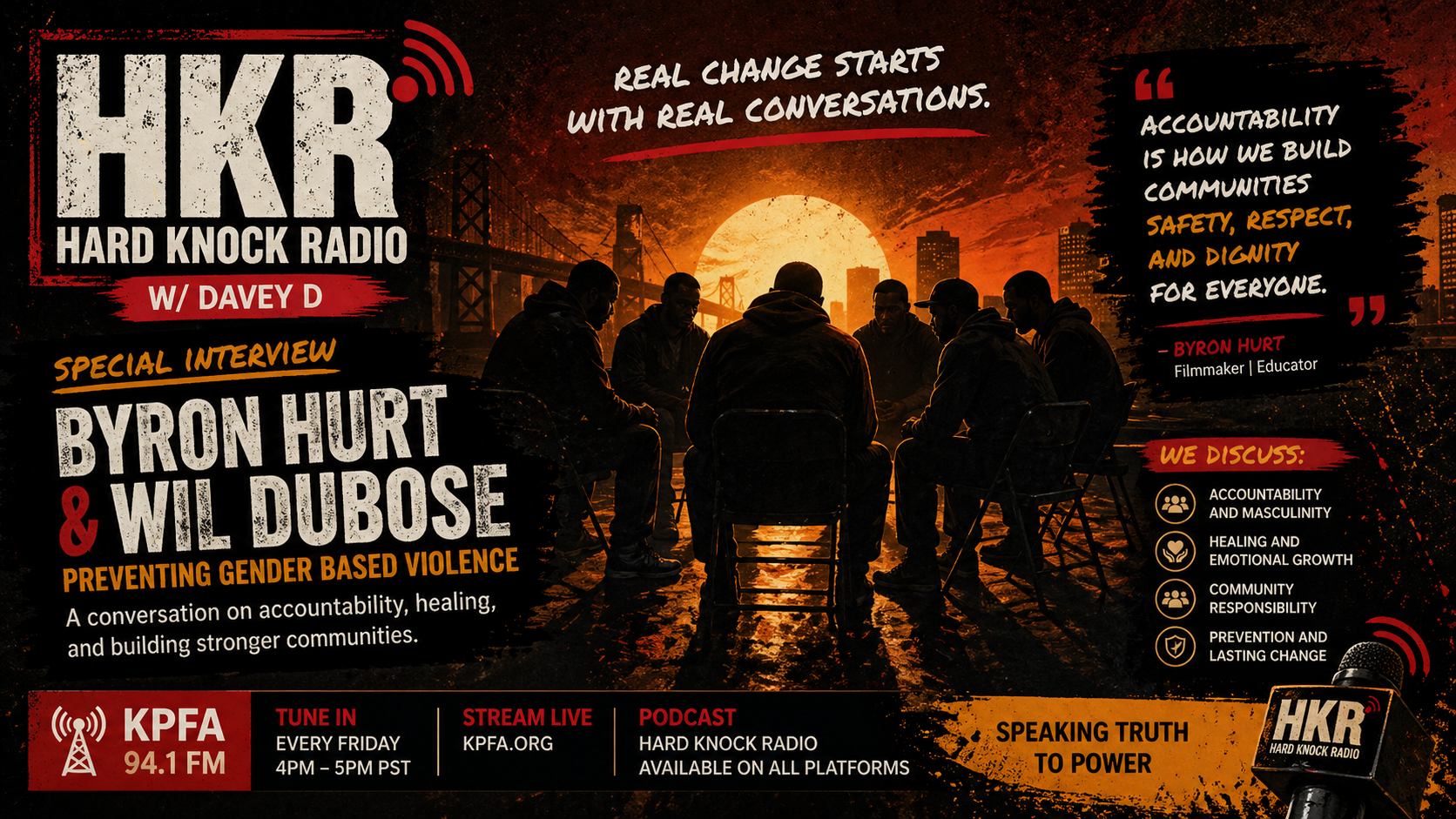
(HKR-04-21-26) Davey D sits down with filmmaker Byron Hurt and Wil DuBose of the Men of Courage program for a critical conversation on preventing gender based violence and the role men must play in addressing harm within their communities. The discussion is grounded in both lived experience and long term work engaging Black and Brown men in accountability and transformation.
Byron Hurt reflects on his documentary work, which follows men participating in prevention programs designed to challenge harmful behaviors and attitudes. He emphasizes that real change requires more than surface level conversations. It demands deep reflection, honesty, and a willingness to confront uncomfortable truths about power, masculinity, and violence.
Wil DuBose expands on this by discussing the importance of creating safe spaces where men can be vulnerable and hold one another accountable. He explains that many men have not been taught how to process emotions or address trauma, which can lead to cycles of harm. Programs like Men of Courage work to interrupt those patterns by fostering dialogue, mentorship, and community responsibility.
Davey D pushes the conversation further by highlighting the contradiction within communities where certain codes of conduct are strictly enforced, while violence against women and girls is often minimized or ignored. He challenges listeners to rethink what accountability looks like and to consider how cultural norms can shift to prioritize safety and respect.
The interview ultimately calls for a collective commitment to ending violence through education, intervention, and sustained community engagement.
Guests: Byron Hurt, Filmmaker and Educator; Wil DuBose, Men of Courage Program
Host: Davey D, Hard Knock Radio
Topic: Gender based violence, accountability, prevention, community responsibility
Key Takeaways
- Preventing gender based violence requires active participation and accountability from men
- Byron Hurt’s documentary work highlights real world prevention efforts
- Wil DuBose emphasizes vulnerability, mentorship, and peer accountability
- Cultural contradictions often allow harm to go unchallenged
- Long term change requires consistent community engagement
Key Quotes / Moments
- Accountability must be consistent across all forms of harm
- Silence enables violence to continue
- Prevention is a sustained practice, not a one time intervention
Segment Breakdown (10 Minute Intervals)
0:00 – 10:00 | Framing the Crisis and Setting the Tone
Davey D opens with a serious framing of gender based violence, referencing recent incidents and broader patterns that have made this issue unavoidable. He sets a tone that this is not just a conversation but a necessary intervention. Byron Hurt and Wil DuBose are introduced not just as guests, but as individuals deeply engaged in confronting violence within communities.
This segment establishes the urgency of the discussion and makes clear that the focus will be on accountability, not just awareness. Davey positions the conversation within a larger cultural context, asking why certain behaviors are normalized or ignored, and what it will take to shift that reality.
10:00 – 20:00 | Byron Hurt’s Film Work and What It Reveals
Byron Hurt dives into his documentary work, explaining how he came to focus on men’s violence against women and the process of documenting prevention programs. He shares insights into what he observed while working closely with men attempting to change their behavior.
The conversation highlights how deeply rooted these issues are, often tied to learned behaviors, trauma, and societal expectations around masculinity. Byron stresses that prevention is not about quick fixes but about long term engagement and reflection. Davey D draws connections between Byron’s work and broader cultural narratives, including how media and Hip Hop sometimes reflect or challenge these dynamics.
20:00 – 30:00 | Wil DuBose and the Work of Men of Courage
Wil DuBose brings the conversation into practical application by discussing the Men of Courage program. He explains how the program creates structured spaces for men to talk openly, confront their actions, and support each other in making changes.
Wil emphasizes that many men lack the tools to process emotions or communicate effectively, which can lead to harmful behaviors. The program focuses on building emotional awareness, accountability, and peer support. Davey D highlights how rare these spaces are and why they are essential in breaking cycles of violence.
This segment grounds the conversation in real world solutions, showing what prevention work actually looks like on the ground.
30:00 – 40:00 | Cultural Contradictions and Community Accountability
Davey D pushes the conversation into deeper territory by addressing contradictions within communities. He points out that certain codes, like not cooperating with law enforcement, are enforced strongly, while violence against women and girls often does not receive the same level of response.
This sparks a critical discussion about values, priorities, and cultural norms. Byron and Wil reflect on how silence, denial, and minimization contribute to ongoing harm. The segment challenges listeners to rethink what accountability means and how communities can shift toward protecting those most vulnerable.
This is one of the most pointed parts of the conversation, where the critique becomes sharper and more direct.
40:00 – End | Pathways Forward and Collective Responsibility
The final segment turns toward solutions and next steps. Byron Hurt and Wil DuBose outline what meaningful prevention looks like, including education, early intervention, and sustained engagement with men and boys.
They stress that this work cannot be left to a few organizations. It requires a collective effort involving families, schools, media, and community institutions. Davey D closes by reinforcing the idea that change is possible, but only if communities are willing to confront uncomfortable truths and take responsibility.
The conversation ends on a note that is both urgent and hopeful, emphasizing that while the problem is deep, so is the capacity for transformation.











Leave a Reply